Shopify vs custom ecommerce website sounds like a simple platform choice, but most businesses are actually deciding between three different things: a standard Shopify build, a heavily customised Shopify storefront, and a fully custom ecommerce stack.
Those are not the same decision. A store can look highly bespoke while still using Shopify for products, inventory, checkout and administration. It can also use a completely custom frontend with Shopify behind it. And at the far end, a business can build and operate its own commerce platform with no Shopify dependency at all.
For most founders, the useful question is therefore not “Which platform is better?” It is: how much control does this business genuinely need, and which parts of ecommerce are worth owning?
First, separate custom design from custom ecommerce development
This distinction removes most of the confusion.
A custom-designed Shopify store still runs on Shopify. The visual system, homepage, collection pages, product pages, navigation and merchandising can be designed around the brand rather than left as an off-the-shelf theme. Shopify still provides the commerce platform underneath.
A headless Shopify storefront goes further. Shopify's Storefront API allows developers to build a separate custom frontend using technologies such as Hydrogen, Next.js or another framework while keeping Shopify's product, cart and commerce capabilities behind it. Shopify itself describes the Storefront API as the foundation for custom storefronts built with the frontend technology of your choice. See Shopify's Storefront API documentation.
A fully custom ecommerce website means the business is taking responsibility for much more of the commerce system itself: application architecture, hosting, deployments, security, product and order logic, integrations, maintenance and future development.
That is why “Shopify or custom?” is often a false binary. There is a substantial middle ground.
Shopify vs custom ecommerce website: the practical differences
1. Time to launch
Shopify normally gives a business more of the operating system on day one. Products, inventory, orders, discounts, analytics, payments, hosting and the merchant admin already exist. The design and configuration work can therefore concentrate on the customer experience rather than rebuilding basic commerce infrastructure.
A fully custom build has a longer path because the team must decide what the system should do before it can build it. That becomes worthwhile when the business model itself is unusual, but it is unnecessary overhead when the requirement is a conventional online store with excellent branding and merchandising.
For a new or still-validating brand, speed has strategic value. Money spent recreating commodity infrastructure is money that is not being spent on product, photography, inventory, acquisition or customer experience.
2. Design freedom
This is where the comparison is often oversimplified.
Shopify does not mean the store has to look like a generic template. A properly customised storefront can have a distinct editorial system, unconventional section rhythm, custom collection navigation, product storytelling, video, lookbooks, interactive merchandising and a strong mobile experience.
The real constraint appears when the desired experience conflicts with how the platform expects commerce to work. The further a requirement moves away from normal products, carts, customers, discounts, markets and checkout flows, the more development effort is required.
A fully custom build gives the development team more freedom because the application itself is being defined. But freedom also creates more decisions, more code and more responsibility. “Anything is possible” is useful only when the business genuinely needs something unusual.
3. Checkout control
Checkout is an important dividing line.
Shopify provides a managed checkout, but the degree of customisation depends on the plan and the type of extension. Shopify's current documentation shows that standard branding and certain app-based customisations are available broadly, while deeper customisation of the information, shipping and payment stages is tied to Shopify Plus capabilities. Review Shopify's current checkout customisation rules.
If a brand needs a conventional retail checkout, that standardisation is usually a benefit. If the business requires a genuinely unusual purchasing workflow, complex quoting, bespoke pricing logic, marketplace behaviour, highly specialised B2B rules or a checkout that does not fit Shopify's model, custom development becomes more relevant.
4. Day-to-day management
Platform choice is not only about what developers can build. It is also about what the merchant team can manage after launch.
Shopify is designed around routine ecommerce operations: products, inventory, collections, orders, discounts, customers and content. That reduces the number of ordinary changes that need a developer.
A custom ecommerce application can also have an excellent CMS or admin, but somebody has to design and maintain that admin. If the internal team is small, the convenience of a mature merchant interface can be more valuable than theoretical technical freedom.
5. Hosting, security and maintenance
Shopify's Australian plans include secure commerce hosting, unlimited bandwidth and SSL, so the merchant does not separately assemble the hosting layer for the online store. Its current Australian pricing page also details plan features, payment rates and platform limits. Check Shopify's current Australian pricing and included features.
With a fully custom build, hosting is only one line item. The business also needs deployment processes, monitoring, backups, security patching, dependency updates, incident response and ongoing engineering ownership.
That does not make custom development bad. It simply means the comparison should include the cost of operating the software, not just the cost of building version one.
6. Integrations and business logic
Shopify has a large app and API ecosystem, which makes many common integrations faster to implement. For standard retail requirements, this can be a major advantage.
Problems emerge when a business is forced to combine several apps to recreate one core workflow, or when critical internal systems do not map cleanly to Shopify's data model. At that point, custom applications, middleware or headless architecture can become more sensible.
The useful test is not “Can Shopify technically do this?” It is “Can Shopify do this cleanly enough that the store remains maintainable?”
7. SEO and performance
Both Shopify and custom ecommerce websites can perform well in search. Neither platform choice automatically creates rankings.
The practical difference is control. Shopify provides a known structure and handles many technical basics, while a fully custom stack can expose more control over routing, rendering, data structures and page architecture. That extra control is useful only if the team has the technical SEO and engineering capability to use it well.
A poorly built custom store can be slower and harder to crawl than a well-built Shopify store. A bloated Shopify theme with too many apps can also become unnecessarily heavy. The implementation quality matters more than the label on the platform.
8. Ownership and dependency
A custom codebase can give a business ownership of more of its application layer, but ownership also means maintenance responsibility.
With Shopify, the merchant owns its brand, products, content and business data, but relies on Shopify's platform, APIs, pricing and product roadmap for the commerce layer. That dependency is the trade-off for managed infrastructure.
For most smaller ecommerce businesses, that trade-off is reasonable. For a company whose technology itself creates competitive advantage, owning more of the stack may eventually become strategic.
The most useful middle option: custom design on Shopify
Many businesses looking at “Shopify vs custom website” are not actually unhappy with Shopify's commerce capabilities. They are unhappy with generic design.
Those are different problems.
If the store sells normal physical or digital products, uses a conventional cart and checkout, and does not need highly bespoke transaction logic, the platform may not be the thing that needs replacing. A stronger brand system, information hierarchy, collection structure, product presentation and mobile experience may solve the real problem.
This is where a premium Shopify design can be much more efficient than commissioning an entire ecommerce platform from scratch.
What this looks like in real Depiction Studio store designs
Divara Couture: Shopify can still feel editorial
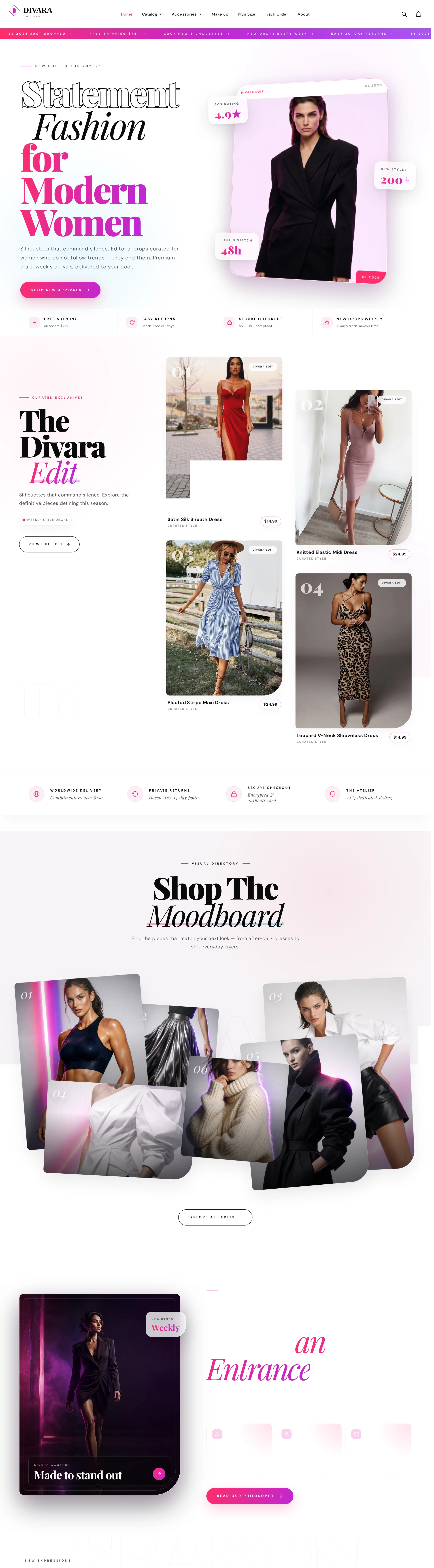
Divara Couture is a fashion storefront in Depiction Studio's Shopify collection. Its homepage is not organised like a default product grid. It uses seasonal editorial framing, featured pieces, brand storytelling, a wardrobe-style product edit, mood-based collection navigation and a focused featured-product moment.
The important point is that platform and visual identity are separate decisions. A brand can retain familiar ecommerce operations while using a much more art-directed storefront.
The Velvet Stone: category-specific merchandising matters
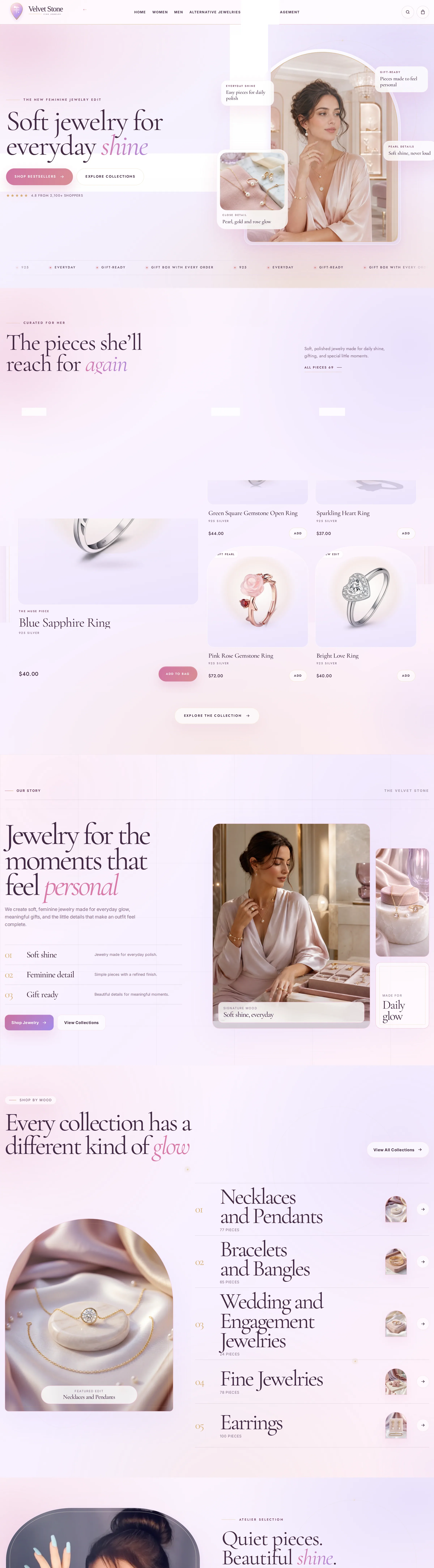
The Velvet Stone approaches ecommerce differently. The storefront uses jewellery categories, curated edits, brand story, a shop-the-look section and gift-oriented presentation. The product hierarchy and visual pacing are specific to jewellery rather than borrowed from a general-purpose store layout.
These two stores are useful examples because they make the same broader point: a Shopify store does not have to inherit one visual personality. The better question is whether the platform can support the business model while the design is customised around the category and brand.
You can browse the wider Depiction Studio Shopify store designs, including fashion, beauty, home, electronics, travel, pets, fitness and other retail categories.
When Shopify is usually the more practical choice
- You are launching or validating a retail brand. The business benefits from getting a strong storefront live without building core commerce infrastructure.
- Your products use conventional ecommerce flows. Standard products, variants, carts, shipping, discounts and checkout fit the platform well.
- Your team wants operational independence. Staff need to update products, collections, content and promotions without relying on developers for routine work.
- Design is the problem, not commerce logic. You need a better-looking and better-structured storefront rather than a new transaction engine.
- You value predictable platform maintenance. Hosting, platform updates and core commerce infrastructure are managed rather than built internally.
When a custom ecommerce build starts to make sense
- The buying flow is genuinely unusual. The product, pricing or transaction model cannot be expressed cleanly through a conventional store.
- Commerce is deeply connected to proprietary software. The ecommerce experience is one part of a larger application or operational system.
- Critical workflows depend on bespoke integrations. The store must interact with internal systems in ways that are difficult to maintain through standard apps and APIs.
- Your business has an engineering team. You have the budget and capability to own infrastructure, releases, security and long-term maintenance.
- The technology itself is strategic IP. Owning the application layer creates real business value beyond visual differentiation.
When headless Shopify is the better answer
Headless architecture is useful when the business wants Shopify's commerce backend but needs substantially more frontend control.
That can be relevant for content-heavy commerce, complex multi-channel experiences, unusual frontend interactions, or brands with an engineering team already working in a modern web stack.
It is not automatically “better Shopify.” Headless adds development complexity, deployment responsibility and more moving parts. If a well-built Shopify theme can deliver the required experience, headless may simply increase cost without creating meaningful customer value.
Cost: compare total operating cost, not just build price
A useful comparison includes four buckets:
- Initial design and build. Strategy, UX, visual design, development, content and migration.
- Platform or infrastructure. Shopify subscription and relevant apps, or custom hosting and infrastructure.
- Ongoing changes. Theme development, app configuration or custom engineering.
- Maintenance risk. Security, upgrades, integrations, monitoring and what happens when a dependency changes.
Shopify often has a lower infrastructure burden but recurring platform and app costs. A custom build can have higher upfront and engineering costs while giving the business more control over what it owns. The right comparison is the cost of operating the store for several years, not the first invoice.
For Australian ecommerce businesses, the platform does not replace compliance
Platform choice does not remove the merchant's legal responsibilities. The Australian Competition and Consumer Commission states that online businesses must comply with the usual consumer laws, including consumer guarantees, and must not make false or misleading claims. It also highlights clear systems for refunds, problem resolution and protecting customer information as important signals for online buyers. See the ACCC's current guidance for online buying.
That means refund language, product claims, shipping information, contact details and policies need to be handled properly whether the store is built on Shopify or a custom platform.
A simple decision framework
Choose Shopify when the commerce model is conventional, speed and merchant usability matter, and the business would benefit more from investing in brand, merchandising and growth than rebuilding infrastructure.
Choose a custom Shopify design when the store needs to feel distinctive but the underlying commerce model still fits Shopify well.
Choose headless Shopify when you need a highly custom frontend while retaining Shopify's commerce backend and you have the technical resources to support the extra complexity.
Choose a fully custom ecommerce build when the business logic itself is sufficiently unusual or strategically important that platform constraints create real operating problems.
Shopify vs custom ecommerce website FAQ
Is a custom ecommerce website always better than Shopify?
No. It gives the development team more control, but it also creates more engineering responsibility. If the business uses conventional ecommerce flows, a well-designed Shopify store may provide the better balance of flexibility, speed and maintainability.
Can a Shopify store look fully custom?
Yes. The customer-facing storefront can be heavily customised through theme development, and Shopify also supports custom headless storefronts through its Storefront API. The amount of checkout customisation available depends on the plan and extension type.
Which is cheaper: Shopify or a custom ecommerce website?
Shopify usually reduces the cost of building and operating core commerce infrastructure, but it has recurring platform, payment and potentially app costs. Custom ecommerce usually requires more upfront development and ongoing engineering. Compare total operating cost over time rather than only the initial build.
Should a small Australian business build a custom ecommerce platform?
Usually only when there is a clear requirement that standard commerce platforms cannot support cleanly. For a conventional retail store, a customised Shopify build often allows the business to spend more of its budget on brand, products, content and customer acquisition.
See how different a Shopify storefront can look before choosing your build path.
Browse Depiction Studio's Shopify designs across fashion, beauty, home, tech, travel, fitness and other retail categories. View the designs live, then own one or have it customised for your store.
Explore Shopify store designs ↗